
Enrollment at Edmonds College is up! At least, that’s what our college president, Dr. Singh, announced in an email on September 19, 2025.
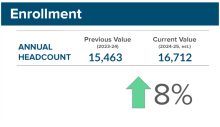
Classes all over the college have full waitlists and students can’t register for the classes they need because sections are full. One might think that this is the perfect time to open more sections and hire more full-time faculty to teach them. Instead, faculty are being pressured to overload their classes, department heads are begging their deans to open more sections, and the new sections that are reluctantly opened by management are being taught by overloaded full-time faculty because there is no time to hire more associate faculty. All of this is leading to burnout for faculty who are being asked to teach more students and more classes.
Edmonds College has been operating this way for some time, but other colleges have not. Data from other community colleges shows that Edmonds College has a lower percentage of full-time faculty by employee headcount than many other colleges in Washington state.

We can only speculate about why refusing to hire more full-time faculty has become the standard operating procedure here at Edmonds College, but it seems like Dr. Singh and VPI Dr. Kim Chapman are balancing the college budget on the backs of its workers.
The Case for More Full-Time Faculty
According to a recent data request from the faculty union, full-time faculty are teaching 33.3% of the FTE at the college. That means that if every student at Edmonds College was taking a full load of classes (at least 12 credits) then full-time faculty would only be teaching one-third of them. The rest of the students at Edmonds College are taught by associate faculty, which comprises both faculty who teach part time at Edmonds College and also full-time faculty who are teaching extra classes (which we call moonlight). We call the number of required classes for full-time faculty our “teaching load” and the standard teaching load for a full-time faculty member is 1.
It is permissible and common for full-time faculty to have a teaching load greater than one. In fact, according to an operational memo published on April 9, 2024, Dr. Kim Chapman stated the following:
Subject: Maximum Teaching Load at Edmonds College
Publish date: April 9, 2024
Purpose:
To support student success by maximizing the diversity of teaching styles, thoughts, opinions,
and personnel, to foster the health and well-being of our employees, and to ensure adequate
staffing levels for classes.
Memorandum:
The maximum teaching load for any employee is 1.50. Exceptions may be considered on a
one-time basis for unplanned extenuating circumstances. Exceptions must be approved by the
dean and VPI, and may not continue on a quarterly basis.
So, according to this memo, faculty can take on extra classes until they are teaching 150% of their usual load without scrutiny. Furthermore, Dr. Chapman acknowledges that this limit is in place “to foster the health and well-being of our employees.”
However, according to a recent data request, 14% of full-time faculty take on teaching loads of over 1.5 for multiple consecutive quarters. If this is happening over and over each quarter, should we really classify that as an “unplanned extenuating circumstance?” Or is this a strategy to coerce faculty, whose only goal is to support the academic success of our students, to take on more classes, teach more students, and thereby burn themselves out so that the college can save money?
Another part of this strategy seems to be pressuring faculty to overload their classes and increase class capacities. Management could be pressuring faculty to overload classes because they get more tuition money without paying the instructor of the class any additional compensation. And when faculty take on these extra students, they demonstrate that the faculty can teach more students in their classes, which means they can increase the capacity for the class. This pressure is even higher for our associate faculty, whose precarious employment can coerce them to fulfill the requests of their dean.
So, we have all of our faculty being pressured to overload classes, we have full-time faculty taking on massive teaching loads every quarter, and management being consistently reluctant to open more sections and hire more faculty to teach them, favoring overloading classes and increasing class capacities instead. Let’s be clear about what this is: a workload crisis manufactured by management to force faculty to do more without less compensation.
But why hire more full-time faculty? If this is an “unplanned extenuating circumstance” as Dr. Chapman calls it, why not hire more associate faculty to cover the extra classes? The faculty union strongly supports our associate faculty and we are thankful for all the work they do for the college. But there is strong evidence that students have better academic outcomes and student retention is higher when there are more full-time faculty at the college. Full-time faculty are compensated for more than just teaching classes. They hold office hours, advise students, support student clubs, and generally support the academic life of the college. Associate faculty do these things as well when they can, but they do it without being compensated.
The Washington state legislature also understands the importance of hiring more tenured faculty at community colleges. That is why they passed SB 5194 in 2021, which states in part:
"The legislature recognizes that student outcomes and success, especially for first generation, underserved students, may be significantly improved by increasing the number of full-time faculty at community and technical colleges."
Hire More Full-Time Faculty!
The issue is clear. Edmonds College has increasing enrollments, and instead of opening more sections and hiring more full-time and associate faculty to teach those classes, Edmonds College is pressuring faculty to overload classes, teach more classes than our own Vice President for Instruction should allow, and in general do more with less. All of this is happening while faculty salaries have remained stagnant for over a decade.
So where is all that additional tuition money going? We know where some of it goes: into the salaries of our management.
| Name | Position | 2020 Salary ($) | 2024 Salary ($) | Change in Salary ($) |
| Singh, Amit | President | 251,700 | 341,300 | +89,600 |
| Chapman, Kimberly | VP of Instruction | 122,400 | 170,900 | +48,500 |
| Moreau, Suzanne | VP of Human Resources | 139,900 (in 2023) | 161,400 | +21,500 |
| Mulik, James | VP of Finance, Grants, and Institutional Effectiveness | 104,500 | 161,400 | +56,900 |
| Smith, Eva | Chief Information Officer | 105,500 | 144,300 | +38,800 |
It seems clear that while faculty salaries barely keep up with inflation, management salaries continue to skyrocket. So, when management comes to the bargaining table and tells the faculty union that the college can’t afford to raise our wages, try to recall the last time any of the people on the management bargaining team ever refused a pay raise.
Instead of consistently pushing faculty to do more with less pay, less support, and less time, management should be raising our wages and hiring more full-time faculty to support the growing student population. The Faculty Collective Bargaining Team submitted proposals that would do just that on Friday, March 6, in our latest bargaining session. We will be watching for a response from the management team.
In the meantime, the faculty union will be making our case to the Board of Trustees at the next Board of Trustees meeting on Thursday, March 12, 2026, at 3:30 pm in Gateway Hall Room 352. A member of the Faculty Collective Bargaining Team, Mary Whitfield, will submit a public comment about this issue to be read aloud to the Board of Trustees. If you can, we encourage you to attend the meeting and show your support for Mary’s statement.